 >
>
常去的那个论坛有两个朋友结婚,我充当了一回网上伴娘。婚礼已至深夜,尽职尽责的我深刻体会到了灌水的辛苦。
“去睡觉吧。”
“嗯,过了12点吧。”
“为什么?”
“呵呵,某在迎接生日。”
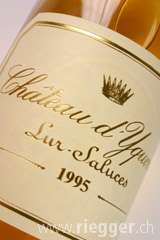
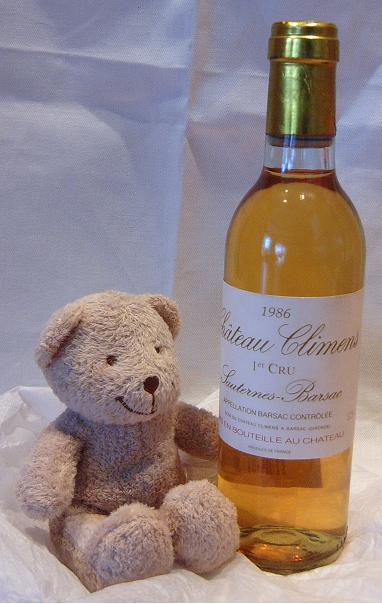
于是,我得到了一份生日礼物——仅次于Chateau d’Yquem的——Chateau Climens 1986。
说实话,接过这支酒的时候,我只看懂了1986和1er cru,而这已经足以让我兴奋。酒标设计简单而精致,与酒的颜色很相称。非常喜欢。同事紧紧握在手中:“这酒很难找的。大部分的酒不是标Sauternes就是标Barsac,而同时标Sauternes-Barsac非常少。并且这酒只产375ml的。”
对甜酒,以前真的只知道Chateau d’Yquem,百尝将其形容得极其美妙:“霎时舌上仿佛一片花海一下子绽放开来的感觉——舌上的花季。”连Lafite都发出:“绝对是:此酒只应天上有,人生那得几回尝”的感叹,更使我感觉这酒遥不可及。对于遥不可及的东西,我只看看。:)
而现在,我手上这支是仅次于Yquem的。噢,天哪。我知道她是一瓶好酒,可我没想到这么好!George Heritier的品酒记录是:“1986 Chateau Climens Sauternes- Barsac (12 % alc.): One of the most amazing dessert wines I've ever tasted, this rich gold exuded huge apricot/oak/vanilla/ spice flavors and aromas, with an unctuous texture and an endless finish.”OH,endless finish!我已经陶醉了。。。
“这酒可是名声和口感仅次于Chateau d’Yquem 的。”
“唔,感激涕临啊。”
“没找到81年的,只好凑数了。”
“咳,已经受之有愧了!”
仅次于Chateau d’Yquem 的——我已经语无伦次了。。。
 >
>
附:
Chateau Climens
 >
>
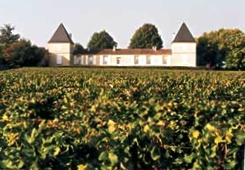
Chateau Climens is one of the Premier Cru properties of Sauternes, as determined in the 1855 classification of Sauternes and Barsac. It is situated in Barsac, close to Chateau Coutet, it's main Barsac rival, and the three deuxième cru Doisy properties. It is the leading property of this Sauternes commune, and in terms of buying and drinking on a regular basis it is for many the leading estate of Sauternes as a whole.
Chateau Climens has a lengthy and well documented history stretching back over 500 years, although viticulture was not undertaken here until the 17th Century. Throughout Climens' early history it was owned by the Roborel family, who oversaw the production of both white and red wines, although obviously today Climens produces no red. In 1802 the family sold the estate to Jean Binaud, and during the 19th Century there were several owners, one of the most useful being the Lacoste family who replanted the vineyards and also saw the estate classified as a Premier Cru. In 1885 the estate came into the hands of the Gounouilhou family. Henri Gounouilhou and his descendants oversaw a golden age for Climens, as the chateau grew not only in size but in reputation, producing wine which in some vintages rivalled d'Yquem. Nevertheless, by 1971 the family had to sell, and so the estate came to Lucien Lurton, head of the Lurton family, who own a number of Bordeaux chateaux including Brane-Cantenac and Durfort-Vivens. Lurton acquired Climens together with Doisy-Dubroca at a time when Sauternes seemed sadly neglected by wine-drinkers who would clamour for red Bordeaux. Things now seem to have changed and Lurton's purchase looks to have been a great investment; recent vintages of Climens have seen the price creeping upwards.
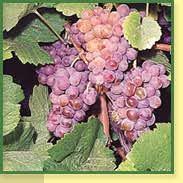
There are 29 ha of vineyards at Climens, in two blocks adjacent to the house, planted entirely to Semillon, vines with an average age of 35 years. The land is a highpoint for Barsac, although it is actually at an elevation of only 20 m. Drainage is good, the soil being sand and gravel over limestone. Yields vary with the vintage, swinging between an incredibly low 9 hl/ha and a huge 25 hl/ha, the latter being in the great 1986 vintage; remember that the methods behind producing Sauternes will always mean yield figures are low when compared with those for dry red Bordeaux. The grapes are harvested in successive tries with careful selection in the vineyard, before a horizontal pressing and fermentation and maturation in separate lots. Chaptalisation may be employed, but rarely. The wine spends up to two years in oak, up to two thirds of which may be new each vintage. Production is typically 3000 cases per annum. The grand vin is Chateau Climens, there is also a second wine Cyprès de Climens. The style of wine is elegant, racy, with great vibrancy, all hallmarks of good Barsac. But Climens has the potential to develop greatly with bottle age, taking on a plump, rich opulence. These are great wines and I have many vintages cellared. (17/8/04)
-----------出自http://www.thewinedoctor.com/bordeaux/climens.shtml
Sauternes & Barsac 1855 Classification
The chateaux of Sauternes were classified, along with those of the Médoc. It was originally drawn up by the Bordeaux Chamber of Commerce for the 1855 Exposition Universelle de Paris, at the request of Emperor Napoleon III. The Bordeaux négociants already had firmly established league tables, based largely on price (and therefore quality), and this knowledge formed the basis for this particular Bordeaux classification.
Premier Cru Supérieur
· Chateau d'Yquem
Premiers Crus
· Chateau Climens
Chateau Clos Haut-Peyraguey
· Chateau Coutet
· Chateau Guiraud
· Chateau Lafaurie-Peyraguey
· Chateau Rabaud-Promis
· Chateau de Rayne-Vigneau
· Chateau Rieussec
· Chateau Sigalas-Rabaud
· Chateau Suduiraut
· Chateau La Tour-Blanche
Deuxièmes Crus
· Chateau d'Arche
· Chateau Broustet
· Chateau Caillou
· Chateau Doisy-Daëne
· Chateau Doisy-Dubroca
· Chateau Doisy-Védrines
· Chateau Filhot
· Chateau Lamothe
· Chateau Lamothe-Guignard
· Chateau de Malle
· Chateau de Myrat
· Chateau Nairac
· Chateau Romer du Hayot
· Chateau Suau
----出自http://www.thewinedoctor.com/regionalguides/bordeauxclassificationssauternes.shtml
 >
> >
> >
>


 >
>  >
>
 >
> >
> >
>  >
> >-
>- >
> >
>  >
> >-
>-  >
> >-
>-  >
> >
>  >
> >
>